
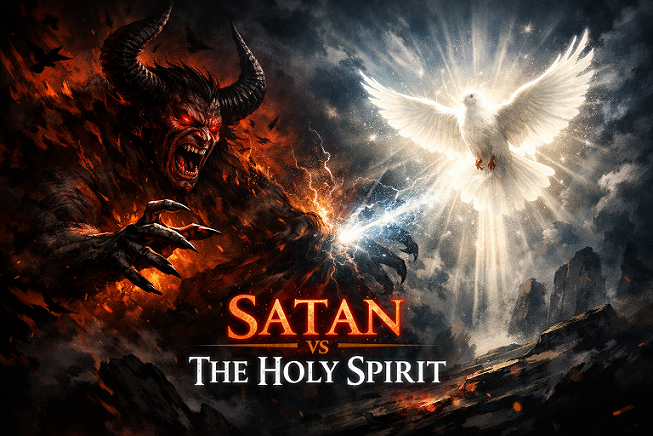
In Scripture, Satan’s attitude toward the Holy Spirit is one of opposition, deception, and spiritual warfare. He does not respect or acknowledge the Holy Spirit as God’s divine presence and guide; instead, he seeks to undermine, deceive, and resist its work.
Biblical portrayal of Satan’s opposition
Acts 5:3 shows Peter confronting Ananias for lying to the Holy Spirit. Peter’s question, “Why has Satan filled your heart to lie to the Holy Spirit?” reveals that Satan is the source of the temptation to deceive God’s Spirit.
This indicates that Satan’s goal is to corrupt human will so that people resist or oppose the Holy Spirit’s guidance.
Satan is described as a spiritual being—originally an angel who rebelled against God—operating in the unseen realm to deceive humanity (2 Corinthians 4:4; Revelation 12:9). His nature is one of malignant subtlety (Acts 5:3) and deception (John 8:44), and he works to blind people’s minds so they cannot recognize truth (2 Corinthians 4:4).

Satan’s strategies against the Holy Spirit
In spiritual warfare, Satan is portrayed as the master of deception (5:5). He uses cunning schemes to lead people away from the Holy Spirit’s guidance, often by exploiting human weaknesses like pride, lust, and fear. His aim is to make people act on their own will rather than submit to God’s Spirit, which is why lying to the Holy Spirit is considered a grave sin—because it is resistance to God’s light and truth.
The Holy Spirit’s work vs. Satan’s work
The Holy Spirit’s work is to enlighten, guide, and sanctify (4:4), bringing purity, love, and willingness to submit to God. In contrast, Satan’s work is to deceive, tempt, and cause people to reject God’s truth. This creates a direct spiritual conflict: the Holy Spirit seeks to draw people into God’s will, while Satan seeks to keep them in rebellion.
Core Takeaway
Christian teaching consistently portrays Satan as hating, opposing, and blaspheming the Holy Spirit, because the Spirit is the power of God that exposes, restrains, and defeats him.
1. Satan Hates the Holy Spirit
Peter Mead’s theological analysis states plainly: “Satan hates the Holy Spirit.” The logic is simple:
- Satan hates God.
- The Holy Spirit is God.
- Therefore, Satan hates the Spirit and works to undermine anything the Spirit does.
This hatred shows up in:
- Attacks on the doctrine of the Trinity (cults twisting the Spirit’s identity).
- Attempts to counterfeit or distort spiritual experiences.
- Resistance to the Spirit’s work in believers, especially conviction, unity, and sanctification.

2. Satan Blasphemes the Holy Spirit
In the Gospels, Jesus confronts a moment where the Pharisees accuse Him of casting out demons “by the power of Beelzebul.” Jesus responds by saying He casts out demons by the Spirit of God, and warns that blasphemy against the Holy Spirit is uniquely unforgivable.
This moment reveals:
- Satan’s strategy is to slander the Spirit’s work, calling God’s power “evil.”
- The Pharisees echo Satan’s thinking by attributing the Spirit’s work to demonic power.
This is the clearest biblical picture of Satan’s “thought” toward the Spirit: accusation, slander, and denial of the Spirit’s authority.
3. Satan Opposes the Spirit’s Influence
Literary and theological analysis (e.g., Paradise Lost studies) describes Satan and the Holy Spirit as opposite influences on humanity:
- The Spirit leads toward faith, obedience, and truth.
- Satan leads toward pride, rebellion, and deception.
This is not equal power—Christian theology teaches the Spirit infinitely outranks Satan—but the oppositional relationship is central.
4. Satan Rejects the Spirit’s Personhood
Some theological discussions note that certain groups reduce the Holy Spirit to “impersonal power,” similar to how they treat Satan as a symbol rather than a being. This distortion aligns with Satan’s goal of undermining the Spirit’s identity.

5. Why Satan’s Opposition Matters
Satan’s hostility toward the Holy Spirit is not abstract—it shows up in everyday spiritual life:
- Confusion about the Spirit’s identity
- Resistance to conviction of sin
- Division within the church
- Counterfeit spirituality
- Attacks on truth, Scripture, and unity
Where the Spirit brings clarity, Satan brings distortion.
| Aspect | Holy Spirit | Satan |
|---|---|---|
| Nature | God, third Person of the Trinity | Created being, fallen angel |
| Mission | Truth, holiness, conviction, unity | Deception, temptation, division |
| Power | Casts out demons (Matt 12:28) | Opposes but cannot overpower the Spirit |
| Attitude | Love, righteousness | Hatred, blasphemy, slander |
| Influence | Leads to Christ | Leads away from Christ |
Summary
Satan’s “view” of the Holy Spirit is hostile and adversarial—he sees it as a divine authority to be resisted and a source of truth to be hidden. His strategies include deception, temptation, and spiritual blindness to prevent people from aligning with the Holy Spirit’s guidance.
In Scripture, resisting the Holy Spirit is equivalent to resisting God Himself, and Satan is the one who tempts people to do so.